Synthesis Essay
Yazmin Feliz
Essay Context:
This essay examines how different English accents challenge the idea of a single “standard” way of speaking in the United States. Using historical evidence, research studies, and class readings, my essay explains how accent discrimination developed and why certain accents are judged more positively than others. The goal is to show that English in America has always been diverse, and that no accent should be seen as less intelligent, less professional, or less correct.
Accents in Standardized English
The issue of accent discrimination in Standardized English goes back hundreds of years, beginning in the1600s. As Taylor Gilbert, explains in his writing “The birth of Black America”, the first recorded arrival of enslaved Africans in the English colonies occurred in 1619 and brought to the Americas by English colonizers. When the United States was formed it was never a nation of one language. “For the first time in its nearly 250 years of history, the US is set to have an official language” As stated by iflscience, published on march, 2025, the United States never had an official language until Donald Trump signed an executive order that designated English to be the nationally designated language of the country 8 months ago. From the very first beginning of the 1600s century, people from all over the world were forcefully brought and migrated to the United States, each carrying their own ways of speaking and their own accents. As supported by Smithsonian Magazine, when English colonists first arrived in North America they landed on the East Coast, establishing English-speaking communities in the North and the South. The French, the Dutch, the Spanish and other European powers also introduced their own languages as they colonized different parts of the continent. Later, “The American Dream” influenced the constant increase of migration. As all of these groups interacted, English developed differently in each community, being shaped by cultural background. Today, supporting evidence from World Population Review, the United States is known as the country with the biggest immigrant population, counting with 50.06 millions immigrants. Yet, despite this diversity, society often promotes the idea that there is only one correct and proper way to speak the English language.
Top 10 Countries with the Highest Number of Immigrants (United Nations 2020)
| United States | 50.6M |
| Germany | 15.8M |
| Saudi Arabia | 13.5M |
| Russia | 11.6M |
| United Kingdom | 9.4M |
| United Arab Emirates | 8.7M |
| France | 8.5M |
| Canada | 8M |
| Australia | 7.7M |
| Spain | 6.8M |
The United States is home to the highest number of immigrants in the world. An estimated 50.6 million people in the United States—a bit more than 15% of the total population of 331.4 million
In a linguistically diverse world, how do different English accents challenge the idea that there can be only one ‘standard’ way to speak the language? After research in the official web of United States Census bureau, in December 2024, the census announced that a net of 2.8 million people migrated to the United States between 2023 and 2024. Worldwide, the United States is home to many more immigrants than any other country. Because these migrants come from different regions of the world, they bring with them their own languages, accents, and cultural ways of communicating. That is why English sounds different depending on where someone is from. With Evidence from the source Strommen, published in September, 2025. if you’ve ever traveled throughout the United States: the wide variety of American accents means the English spoken in Boston is very different from that in Texas, California, or even just a few hours away. These variations are not only peculiarities; rather, they are a part of the diverse range of American accents that represent the history, culture, and diversity of the nation. Each accent carries identity, culture, and history. The United States has always been built on linguistic diversity, as describes in Amy Tan’s Mothers Tongue (1990), many people still treat some accents as “educated” or “professional,” while labeling others as “broken,” “incorrect,” or “unintelligent.” This is called linguistic discrimination, and it affects how people are judged in schools, jobs opportunities, and everyday conversations. Many people get judged by their way of speaking and pronunciation. After a reserch in the source of The Ohio State University College of Arts and Sciences, it supported the idea that All over the country, people speak differently. “There are southern accents, New York Accents, Bostonian Accents, etc. And of course, there are accents that can be recognized as coming from other areas and even other countries around the world” With these different pronunciations also come some new vocabulary that aren’t recognized in Standarlized English. The diversity of English accents in the United States challenges the idea that there is only one correct way to speak the language correctly, revealing that “standard English” is more about social power and prejudice than actual correctness.
There are many English accents in the United States, but one specific accent is often treated as the “standard” or “professional” one. Stereotypically Standard English is usually associated with white, middle to upper-class speakers, especially those raised in suburban or educated environments. The research page named Frontier in Communication created an experiment in January 2025 to demonstrate listerners perceptions and attitudes toward certain accents and compared participants’ evaluation of accents in relation to perceived levels of ‘status’ or ‘prestige’ and ‘solidarity’ or ‘social attractiveness’. It was shown that “In which AAVE-speaking defendants were evaluated more poorly than General American English speakers in terms of their socio-intellectual status and aesthetic qualities”.
Because Standard English accent has been linked to power and authority for so long, people assume it is the “correct” way to speak. However, this belief comes from English men from many years ago, not from actual language rules. Linguists Rosina Lippi-Green – English with an Accent (2012) agree that all “dialects and accents follow patterns and structure. For example, African American English, Southern English, and Latino English each have their own grammar and rhythm, just like so-called standard English.” Yet speakers of these accents are often judged as less intelligent or less professional simply because of how they sound. This shows that accent discrimination is really about social stereotypes rather than accents. This is how the idea of “standard English” reinforces classism and racial hierarchy, rather than promoting fair understanding for everyone.
In the article Acheme and Cionea (2022) explain that people form opinions about others as soon as they hear the way they speak. Their study found that speakers with non-standard accents were often judged as less intelligent and less capable than speakers with a standard accent, even when they gave the exact same message. This shows that the problem is not the grammar or clarity of the accent, but the social stereotypes attached to it. As stated in the article “People are not really hearing what is being said, they are reacting to how it sounds”. This evidence supports the claim that other accents that sounds differently from Standard English automatically become viewed as less serious. This unfair judgment leads many people to feel pressured to change or hide their natural accent in order to be accepted. As the article Forbes accents bias states “ Is it because I consider it to be inferior in some way? Or, is it because I know that people with certain regional accents are disadvantaged when it comes to career progression and opportunities in life?” This evidence demonstrates how accents different from Standard English can be considered as less powerful and constanly judged in our society as of less capable of being used in professional careers and bringing less opportunities. The bias toward standard English encourages conformity rather than understanding, and it limits people’s ability to express their true identity. Recognizing these social biases is necessary if we want to create a society where people are valued for what they communicate, not for how closely they match one “ideal” accent.
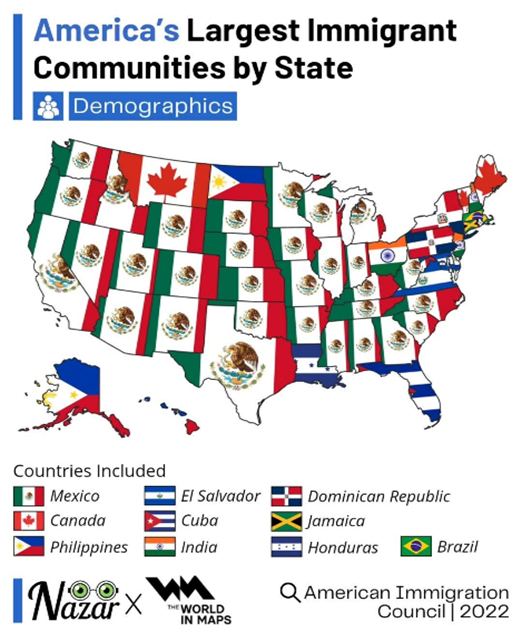
This map tittled “America’s largest immigrant communities by state”, visually demonstrates how linguistically diverse the United States truly is behind the English Language. Each state is labeled with the flag of the country that represents its biggest immigrant population, revealing that millions of Americans come from places such as Mexico, the Dominican Republic, the Philippines, India, Jamaica, Honduras, and many others. This diversity shows that the U.S. has never been a nation with one single way of speaking. Instead, English in America has always been shaped by immigrants who bring their own languages, accents, and cultural backgrounds. The variety of immigrant groups across the country helps explain why there are so many different English accents today and why the idea of enforcing a single “Standard English” is unrealistic. As supported by an article published by Frontiers in Communication “ All speakers have accents” Therefore, not every English speakers will have the same standard English accent. This image reinforces the idea that linguistic diversity is a natural part of American identity.
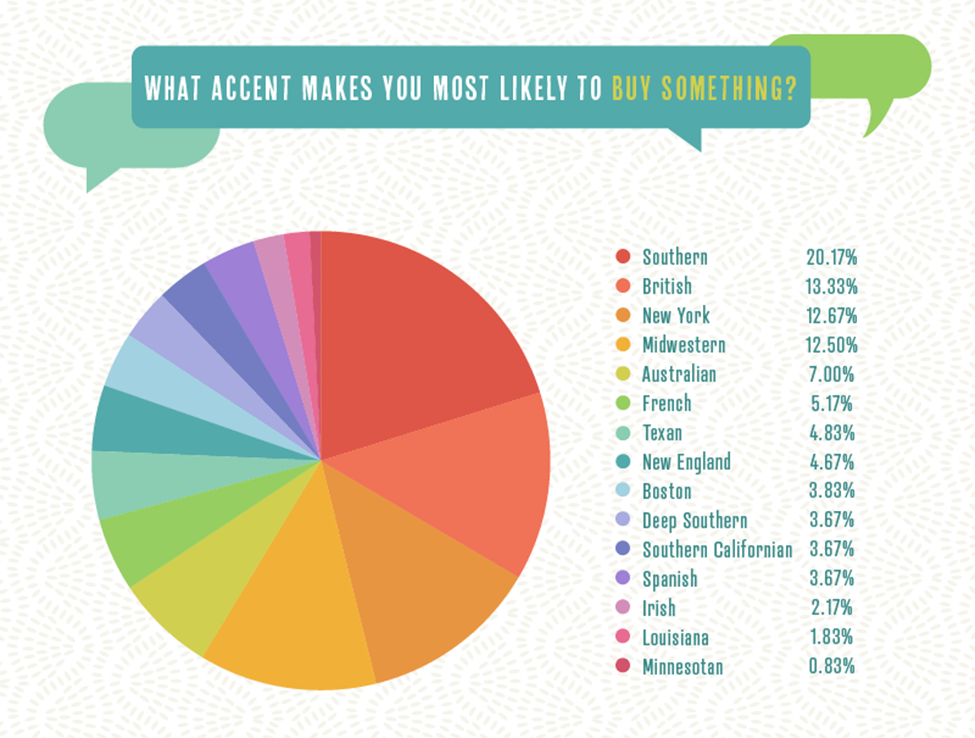
The chart titled “What accent makes you most likely to buy something?” from Moneypenny Resources in which they surveyed over 500 people across the United States to measure how persuasive different accents are. The results show a clear hierarchy of accent preference. Southern, British, New York, and Midwestern accents ranked the highest in persuasiveness. This reveals that Americans make instant judgments based on how a person sounds, even in something as simple as deciding whether to buy a product. The graph proves that accents carry social power and influence how people perceive credibility, intelligence, and trustworthiness. This supports my argument that Standard English is not inherently superior; instead, society has been conditioned to favor certain accents while judging others. In connection to Amy Tan’s “Mother Tongue,” where Tan describes how her mother’s English affected how people respected her, the data visually demonstrates that accent bias is real and continues to operate today.
The diversity of English accents in the United States is not a barrier to communication but a reflection of the country’s history and identity, The evidence gathered across history, research studies, linguistic scholarship, and visual data makes one message clear, there has never been a single “correct” way to speak English in the United States. From the arrival of diverse immigrant communities in the 1600s to the millions of new residents today, the nation has always been shaped by multiple languages, cultures, and voices. Yet society continues to privilege one accent as “standard,” even though that standard is rooted in social power, not linguistic fact. As shown by Amy Tan, Lippi-Green, and contemporary communication research, people are judged not by what they say, but by how closely their accent matches the one society has been taught to value. The map of America’s immigrant populations and the chart on accent persuasiveness further demonstrate that judgments about accents deeply influence opportunity, perception, and credibility. Recognizing this bias is essential if we hope to build a society where all voices are respected. English in the United States has always been diverse and understanding that diversity is the first step toward rejecting the myth of one “proper” English and embracing every accent as valid, meaningful, and worthy of respect
Work Cited:
Acheme, Doris E., and Ioana A. Cionea. “‘Oh, I like Your Accent’: Perceptions and Evaluations of Standard and Non-Standard Accented English Speakers.” Communication Reports, vol. 35, no. 2, 2022, pp. 92–105. https://doi.org/10.1080/08934215.2022.2037679.
Camarota, Steven A., and Karen Zeigler. “Foreign-Born Number and Share of U.S. Population at All-Time Highs in January 2025.” Center for Immigration Studies, 12 Mar. 2025.
Gilbert, Taylor. “The Birth of Black America.” History.com, A&E Television Networks.
Lippi-Green, Rosina. English with an Accent: Language, Ideology, and Discrimination in the United States. 2nd ed., Routledge, 2012.
Tan, Amy. “Mother Tongue.” The Threepenny Review, no. 43, 1990, pp. 7–8.
U.S. Census Bureau. “Improved Method Better Estimates Net International Migration.” Random Samplings, 19 Dec. 2024,
https://www.census.gov/newsroom/blogs/random-samplings/2024/12/international-migration-population-estimates.html.
“Why the USA Did Not Have an Official Language for Almost 250 Years.” IFLScience, https://www.iflscience.com/why-the-usa-did-not-have-an-official-language-for-almost-250-years-78281.
“A Brief History of the United States’ Accents and Dialects.” Smithsonian Magazine, https://www.smithsonianmag.com/history/a-brief-history-of-the-united-states-accents-and-dialects-180983591/.
“Judgements on Accents and Pronunciations: An Inexcusable Reality.” The Ohio State University, 19 Feb. 2021, https://u.osu.edu/writing/2021/02/19/judgements-on-accents-and-pronunciations-an-inexcusable-reality/.
Agarwal, Pragya. “Bias: Is Your Accent Holding You Back?” Forbes, 30 Dec. 2018, https://www.forbes.com/sites/pragyaagarwaleurope/2018/12/30/bias-is-your-accent-holding-you-back/.

